Design around real spaces and real users
A network should reflect the building, number of devices, applications, cable routes, and available internet connection. My vision is to make these decisions easier to understand through clear examples and small, well-documented designs.
A home, a shop, an office, and a camera installation each place different demands on connectivity. Planning should account for those demands before equipment is selected, including how the network might grow.
Make internet choices understandable
Users should be able to distinguish an issue with the internet provider from a local Wi-Fi, cabling, power, or device problem. Practical demonstrations can show how to compare a wired test with a wireless test and record what changes under different conditions.
Fiber, mobile, and satellite connectivity can be discussed as different options with different constraints. Suitability, permissions, provider coverage, pricing, and service conditions need checking for each actual deployment; none should be presented as universally available.
Reduce complexity without hiding important details
My proposed approach includes labelled cables, readable network diagrams, documented device roles, and a record of configuration changes. Even a small installation benefits when another technician can understand it later.
Where supported and appropriate, separate uses such as guest access, cameras, and office work should be considered during design. The details should match the equipment and the user’s operational needs, rather than adding complexity for its own sake.
Support local troubleshooting skills
I want to explain common symptoms in plain language: weak coverage, intermittent links, overloaded connections, and devices that lose power. Lessons should show a repeatable process and explain what each test tells us.
The longer-term aim is to build a library of practical network scenarios that students and technicians can adapt. Performance claims should always be tied to a defined test setup and conditions.
Connect the server, storage, and security layers
A network is the path between users and the systems they depend on. Shared files, server applications, camera recording, and remote work may all need different consideration. My vision is to document those relationships so a network change can be assessed for its wider impact.
Practical examples should show how to plan device placement, record uplinks and power dependencies, and test an agreed use case after a change. Where continuity matters, alternate connectivity and failure handling should be evaluated for that site rather than assumed.
Proposed next steps
- Survey the space, devices, and applications.
- Choose a clear topology and suitable connectivity.
- Label, document, and test the installation.
- Review issues using recorded observations.
What progress should show
- Coverage and performance under stated conditions
- Time needed to isolate common faults
- Completeness of diagrams and labels
- Recurring connection and power interruptions
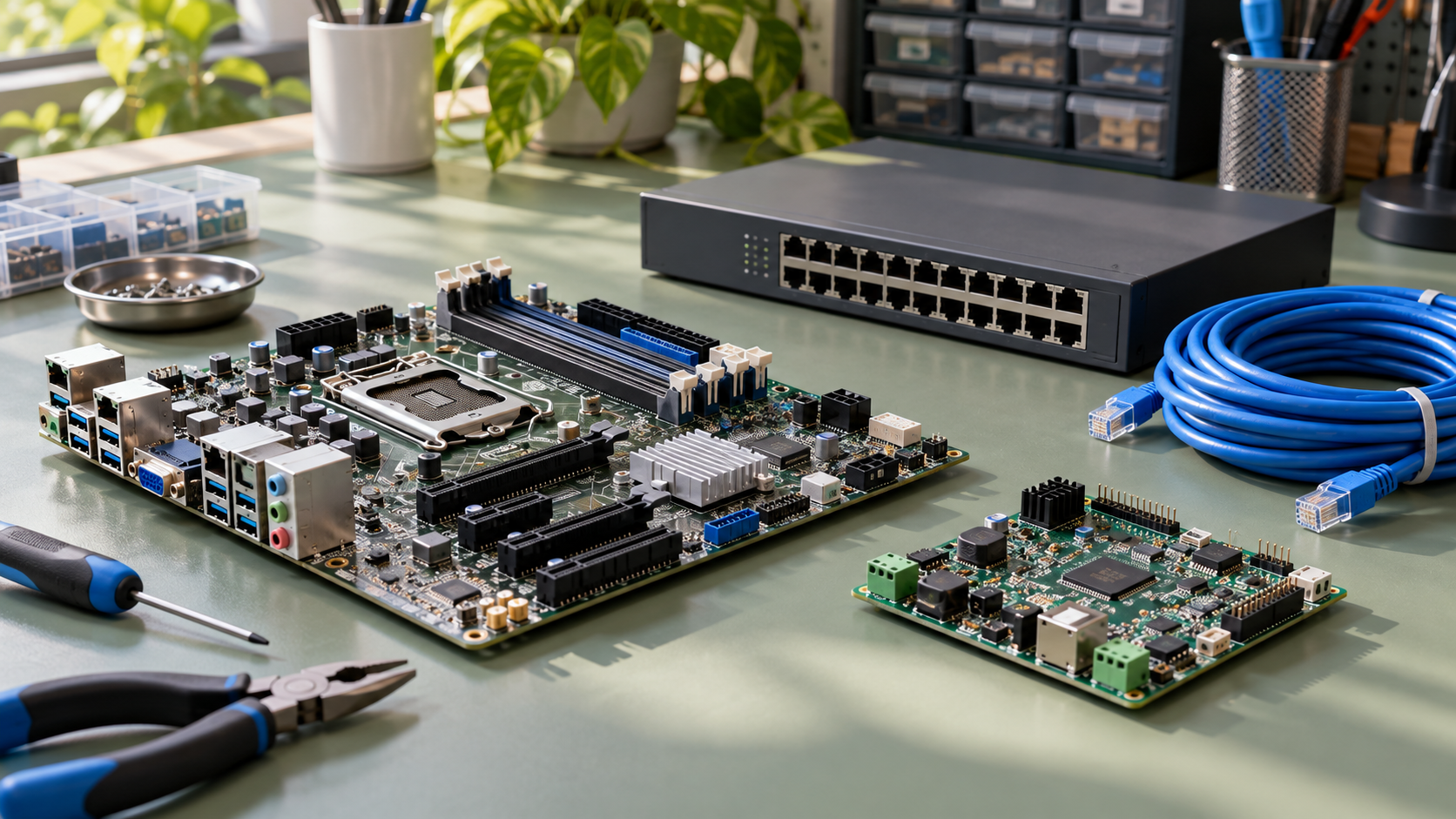
This is Arvind Mishra’s vision and proposed development approach. Future categories, capabilities, partnerships, and milestones are ambitions unless explicitly described as current work. Product photographs are AI-generated illustrations, not photographs of manufactured inventory.